
Your stream in. Paid ads out.
- Your live streamAny HLS URL. Left exactly as it is.
- Ad momentOn your schedule or a SCTE-35 cue.
- StreamAdsProStitches the sponsor in.
- Every deviceTV, phone, set-top box.
- Ads that buffer, skip, or break
- Enterprise ad servers priced for broadcast groups, not one regional channel
- Months of engineering before you earn a rupee
- We stitch your ads into the stream on the server, before it reaches the viewer
- One stream out: the ad plays wherever the stream plays, with no separate ad request to block
- You launch in weeks
Everything you need to run ads
The ad travels inside the broadcast, not as a separate request a blocker can catch.
The proven ways to earn — on a timeline you control.
Point it at your existing live stream. Nothing to re-encode.
Smart TVs, set-top boxes, phones and browsers that already play your HLS. No ad SDK to ship.
How it works
Paste your HLS URL — your stream stays exactly as it is.
Pre-roll before the show, mid-rolls on your schedule.
Impressions are tracked, ready for your revenue reporting.
Launch in weeks, not months — built on proven streaming tech.
$599 per channel per month. No per-insertion or per-impression fee.
A $249 starter month on one channel. Add channels when it pays.
SSAI ad formats, on your live stream
Server-side overlays stitched straight into the broadcast, so they play wherever your stream plays and leave no separate ad request to block.
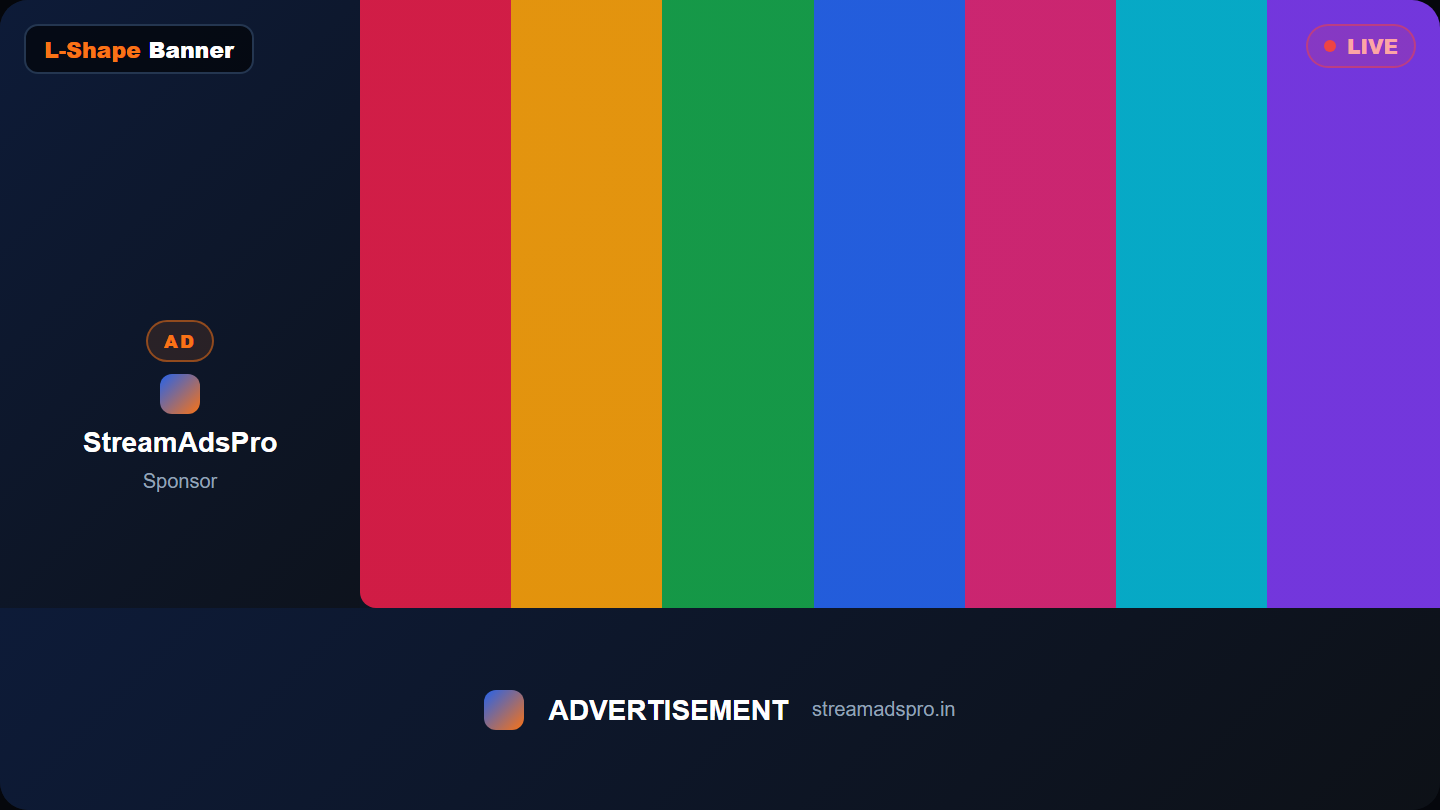
Sponsor stays on screen while the show plays — the broadcast L-bar.
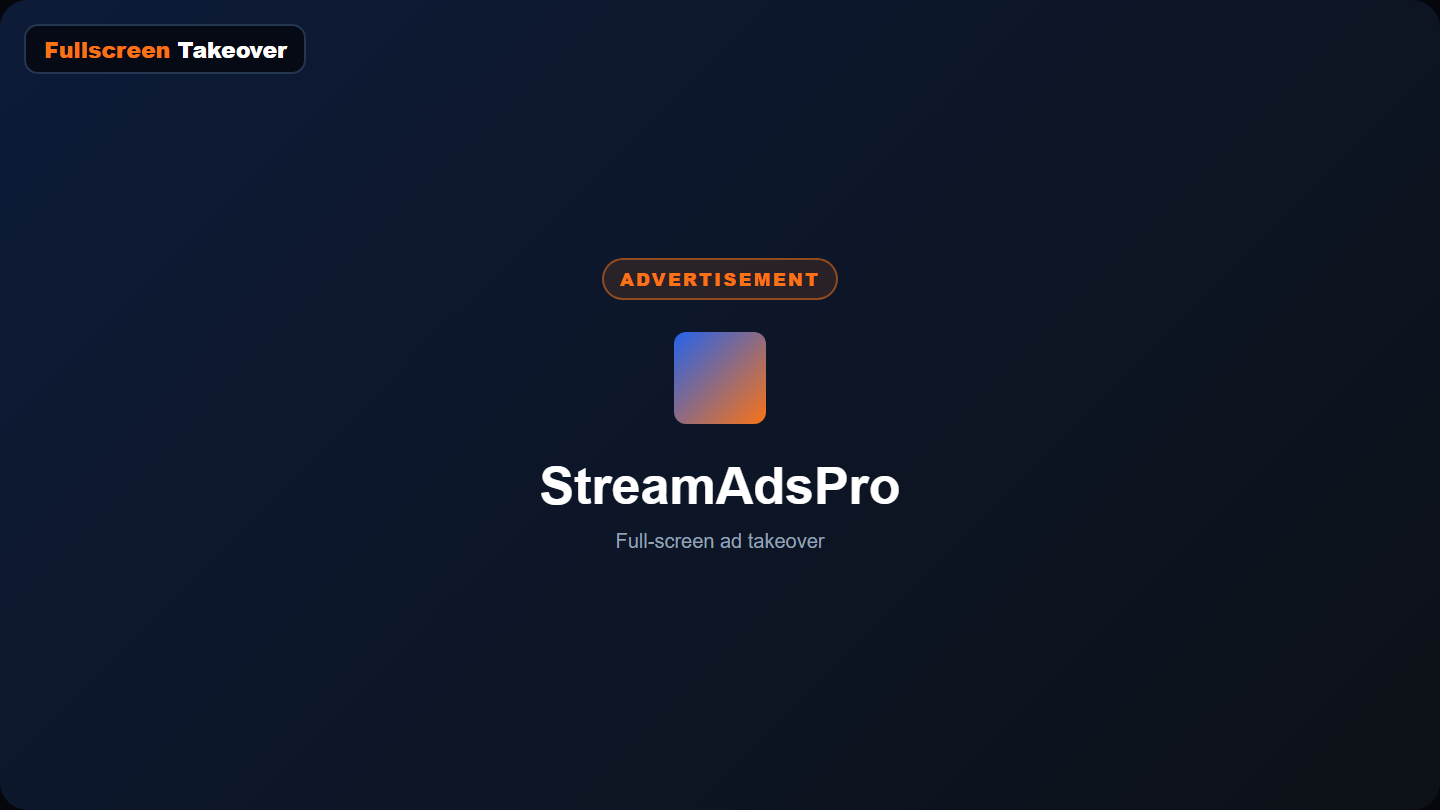
A full ad break stitched right into the stream.
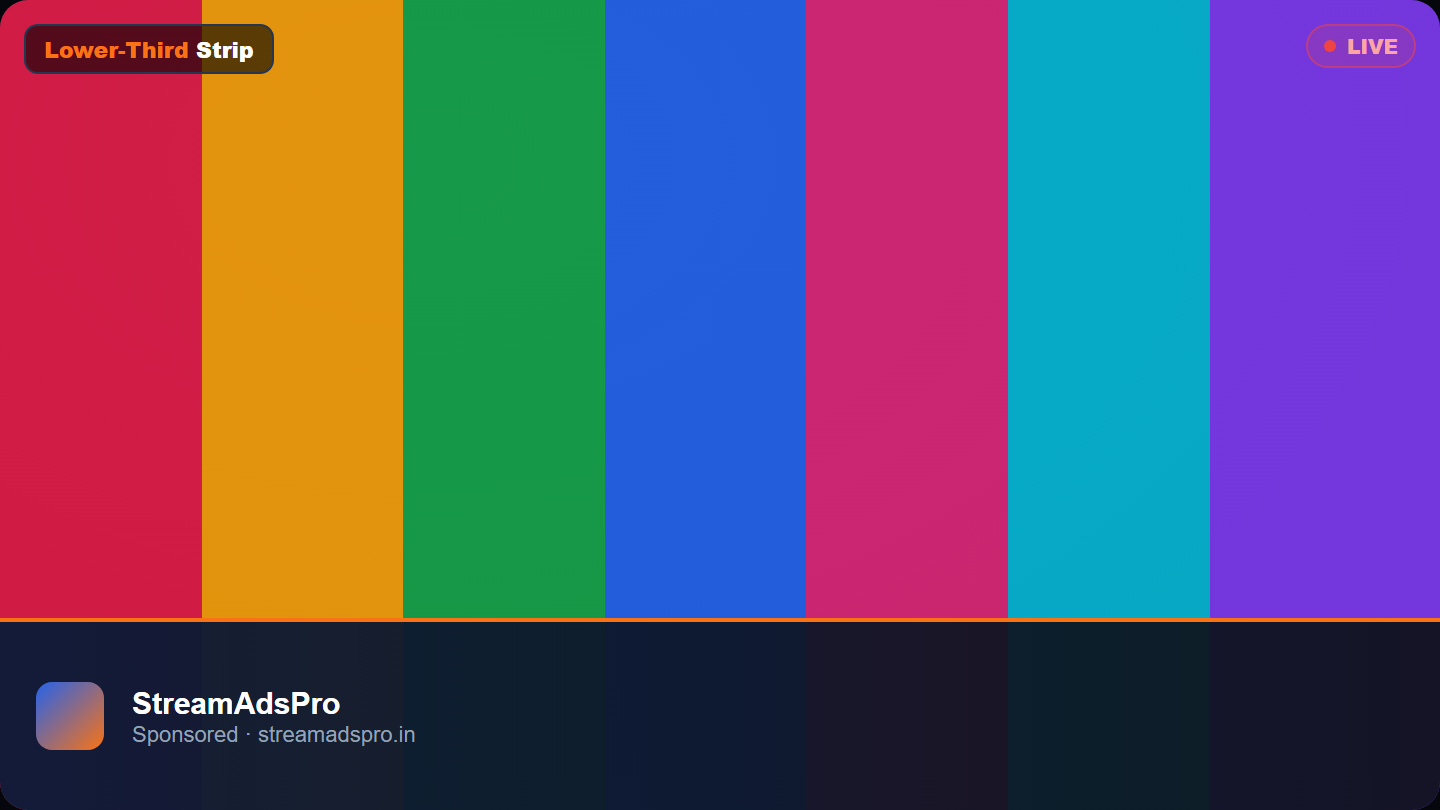
A clean sponsor strip across the bottom third.
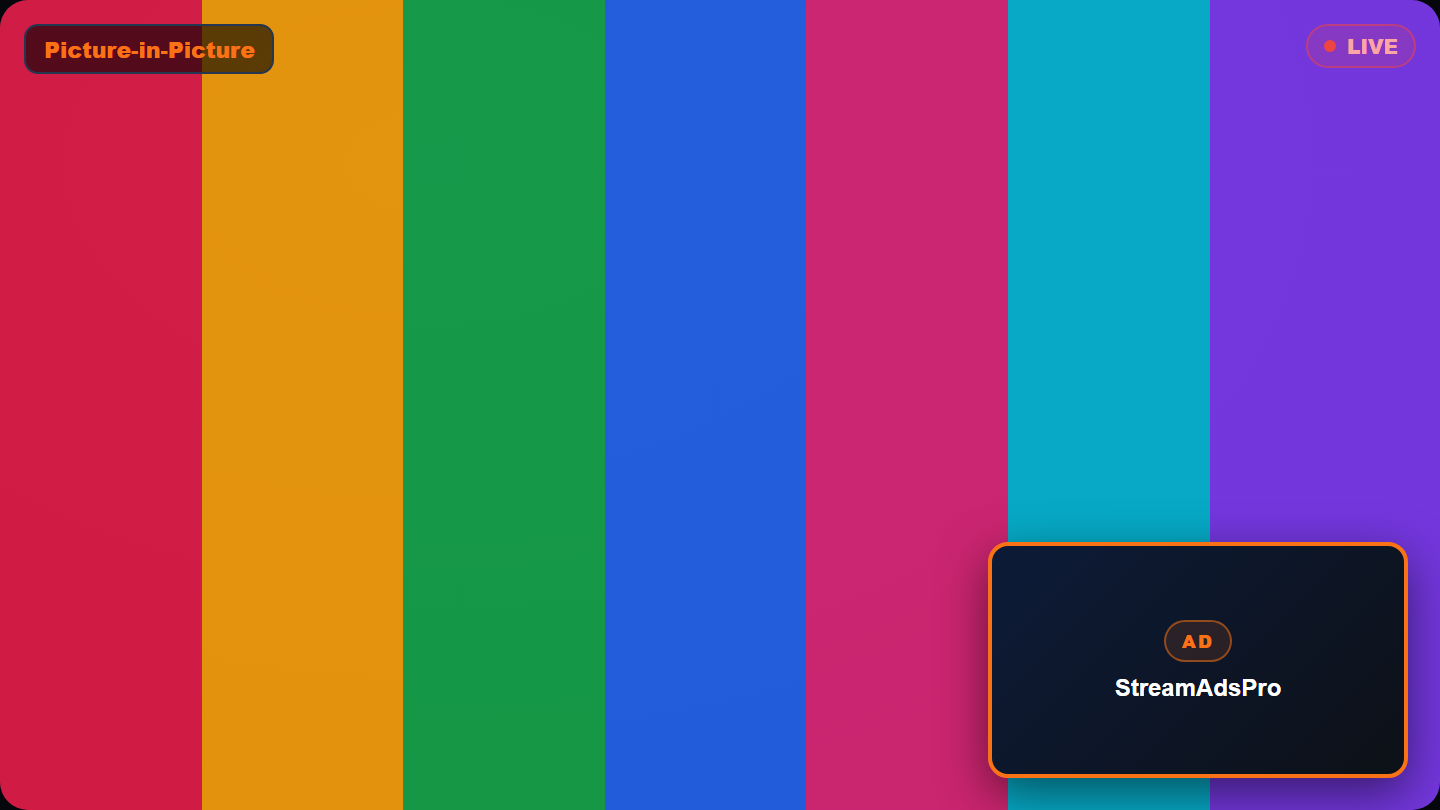
A small ad box in the corner — content keeps running.
Go deeper
Pick the question you are stuck on. Each page answers one.
Why six pages?
Ad insertion is one word covering several very different decisions — which format goes on screen, whether the stitching happens on the server or in the player, and what the encoder actually has to run. Each of those has its own page, and so does the price.
A sponsor frame around the live picture. The show never stops.
What’s inside
The format that wraps a sponsor around the live picture without stopping the programme — how the frame is resized, how many appearances a sponsor gets in a broadcast day, and why it is so hard for an ad blocker to remove.
Ads stitched on the server, or fetched by the player?
What’s inside
The one decision underneath everything else: does the ad go into the video before it leaves the server, or does the player fetch it? Both sides argued honestly, including where client-side is the better answer.
Starter month $249, then $599 per channel per month.
What’s inside
Starter month: $249 for your first 30 days on one channel, you host the infrastructure. Then $599 per channel per month, $400 at 10+ channels. No per-insertion or per-impression fee.
What to test on your own feed before choosing a vendor.
What’s inside
For engineers and evaluators: why an ad break should never force a discontinuity into your playlist, what that costs you on older devices when it does, and the six things worth testing on your own feed before you commit to any vendor.
Managed and usage-billed vs flat-fee and self-hosted.
What’s inside
A managed, usage-billed ad insertion service set against a flat-fee, self-hosted one: where each wins, and the six numbers to count before you price your own channel.
Getting a paying sponsor onto set-top boxes and smart TVs.
What’s inside
Why regional and FAST channels here already own the hard half of the problem, and what it takes to put a paying sponsor in front of an audience watching on set-top boxes and smart TVs.
Working with ad-break markers? We write about SCTE-35 in depth: SCTE-35 cue tones, SCTE-35 ad insertion, SCTE-35 in an HLS manifest, the SCTE-35 validator and SCTE-35 vs ID3 timed metadata.

Video-technology engineer in Thane, India. Send us one live stream URL and we will run a free stream check on your own feed. You get our reply within one working day (IST), from the people who build it, not a sales queue.
Ready to monetize your channel?
Send us one live stream URL. We reply within one working day (IST) with what we found.
Send us your HLS stream URL. We will show you where the SCTE-35 cue is lost.
You get a plain report: which cues are present, whether every break opens and closes, whether the durations agree, and the first hop where the signal disappears. One URL, one working day, and no obligation to buy anything.
Common questions
What is the difference between SSAI and CSAI?
CSAI (client-side ad insertion) inserts ads in the viewer’s browser or app, which allows fine-grained personalisation but can be stopped by ad blockers. SSAI (server-side ad insertion) stitches the ad into the video stream before it reaches the device, so the ad is part of the broadcast: there is no separate ad request for a blocker to catch, and it plays on any device that can play the stream. StreamAdsPro supports both.
What is SCTE-35 and why does it matter for ad insertion?
SCTE-35 is the broadcast standard for signalling ad break opportunities inside a video stream. In HLS these cues appear as playlist tags such as EXT-X-CUE-OUT, EXT-X-CUE-IN and EXT-X-DATERANGE. An ad insertion system reads those markers to know exactly when an ad break starts and how long it lasts. StreamAdsPro can detect existing SCTE-35 markers, insert new ones, and validate the splice_info_section payload.
Can StreamAdsPro work with my existing live stream?
Yes. StreamAdsPro takes an existing HLS stream URL as its input. The stream does not need to be re-encoded or moved, and no change is required at the origin encoder.
Is StreamAdsPro an alternative to AWS Elemental MediaTailor?
It targets the same job for smaller operators. StreamAdsPro is self-hosted on a machine you control and priced at a flat $599 per channel per month ($400 at 10+ channels), with no per-insertion or per-impression fee, rather than a managed cloud service metered by usage. That suits independent FAST channels, regional broadcasters and faith livestreams that cannot justify enterprise ad server pricing.
How can a temple livestream use StreamAdsPro?
For a temple, church or other faith livestream, StreamAdsPro overlays a donation QR code and sponsor thank-you graphics onto the live darshan or service video. Viewers can scan and donate without leaving the stream, and sponsors can be acknowledged on screen without interrupting the broadcast.